How Many Eyes Does a Fly Have? Understanding Fly Vision
An in-depth look at fly eye anatomy, compound vision, and why these common pests are nearly impossible to catch.
Quick Answer
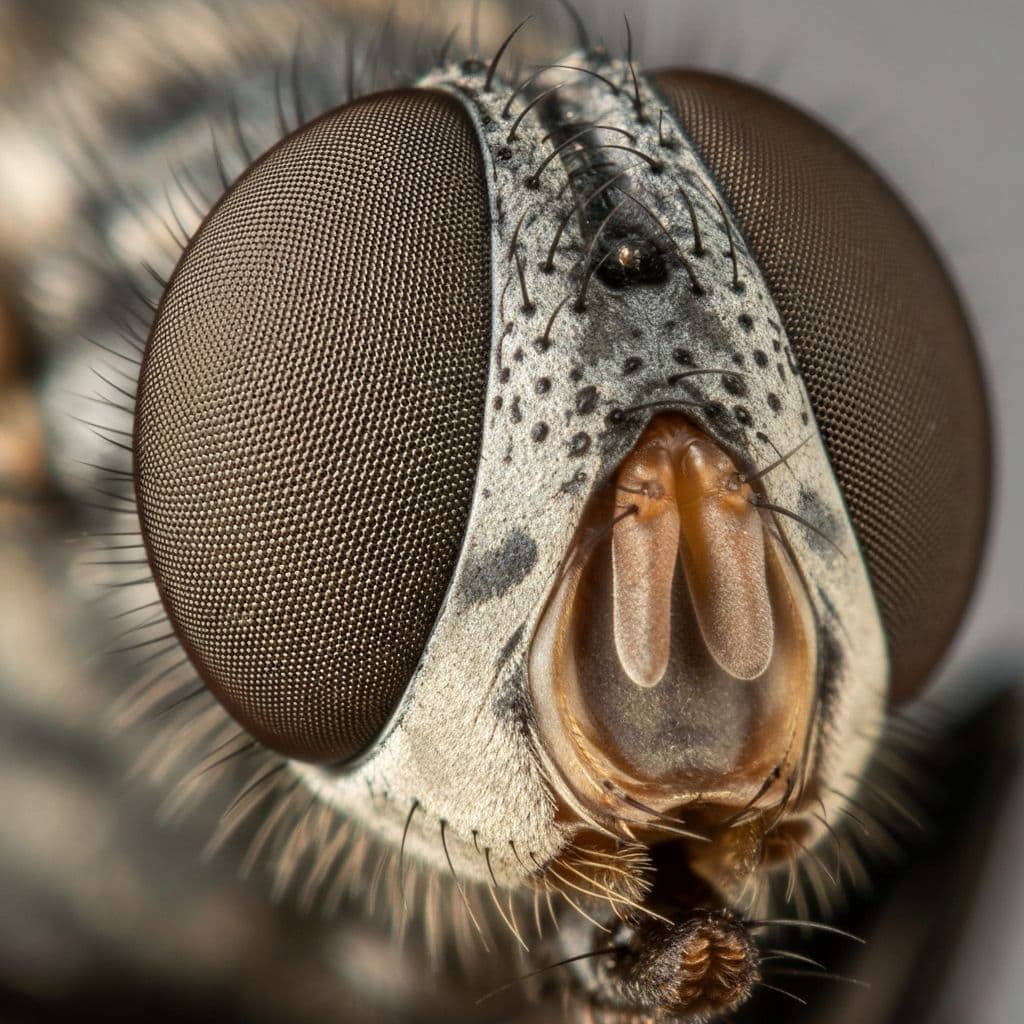
A fly has 5 eyes: 2 large compound eyes containing up to 6,000 individual lenses (ommatidia) each, plus 3 small simple eyes (ocelli) on top of its head. This gives flies nearly 360-degree vision and the ability to process visual information 7x faster than humans.
In This Article
Have you ever wondered why flies are so incredibly difficult to catch? The answer lies in their remarkable visual system. Unlike humans and most mammals, flies possess a completely different type of eye structure that gives them extraordinary abilities to detect motion and escape predators.
In this comprehensive guide, we will explore the fascinating world of compound eyes, understand how flies perceive their environment, and learn why this knowledge matters for effective fly control in your home.
Fly Eye Anatomy Explained
The common house fly (Musca domestica) possesses one of the most sophisticated visual systems in the insect world. Their eyes are divided into two distinct types, each serving different purposes.
2 Compound Eyes
Large, bulging eyes on either side of the head. Each contains 3,000 to 6,000 individual visual units called ommatidia. These provide wide-angle vision and exceptional motion detection.
3 Simple Eyes (Ocelli)
Three small, simple eyes arranged in a triangle on top of the head. These detect light intensity and help with flight stability and orientation rather than forming images.
Together, these 5 eyes create a visual system that processes information faster than almost any other creature on Earth. This is why understanding fly vision is crucial for effective pest control strategies.
How Compound Eyes Work
Compound eyes are fundamentally different from human eyes. Instead of a single lens focusing light onto a retina, compound eyes consist of thousands of tiny independent visual units called ommatidia.
Structure of an Ommatidium
Each ommatidium functions as a tiny independent eye containing:
- Corneal lens: The outer transparent surface that collects light
- Crystalline cone: Focuses light onto the photoreceptor cells
- Photoreceptor cells: Convert light into electrical signals sent to the brain
- Pigment cells: Isolate each ommatidium to prevent light leakage between units
Mosaic Vision
Each ommatidium captures a small portion of the visual field. The fly's brain combines these thousands of individual "pixels" into a mosaic image. While this produces lower resolution than human vision, it provides exceptional motion detection capabilities.
Think of compound eyes like a security camera grid. Each camera (ommatidium) captures a small area, but together they cover a much larger field than a single camera. What flies sacrifice in image sharpness, they gain in coverage and speed.
The 3 Simple Eyes (Ocelli)
In addition to their compound eyes, flies have three simple eyes called ocelli positioned in a triangular pattern on top of their head. These are often overlooked but serve critical functions.
Functions of Ocelli
- Light detection: Sensing overall light intensity and direction
- Flight stabilization: Helping maintain level flight by detecting the horizon
- Fast response: Providing quicker light-change detection than compound eyes
- Circadian rhythm: Helping regulate daily activity patterns
While ocelli cannot form images, their fast response time (even faster than compound eyes) makes them essential for a fly's rapid escape reflexes. When light conditions change suddenly, ocelli trigger immediate flight responses before the compound eyes finish processing the visual information.
How Flies See the World
A fly's visual perception differs dramatically from human vision. Understanding these differences helps explain their remarkable abilities.
Field of View
Flies have nearly 360-degree vision thanks to their large compound eyes positioned on the sides of their head. They can see in front, behind, above, and below simultaneously. The only blind spot is a small area directly behind their head.
Color Perception
Flies see a different color spectrum than humans:
- Ultraviolet light: Visible to flies but invisible to humans
- Blue and green: Highly sensitive to these wavelengths
- Red: Poorly perceived or invisible to most fly species
This is why many insect traps use UV light to attract flies and other flying insects.
Image Resolution
Fly vision has much lower resolution than human vision. If a human has 20/20 vision, a fly would have approximately 20/1200 vision. They see the world as a pixelated mosaic rather than sharp images. However, this trade-off gives them superior motion detection.
Why Flies Are So Hard to Swat
The answer comes down to temporal resolution, which is how fast the visual system can process changes.
| Species | Flicker Fusion Rate | Perception |
|---|---|---|
| House Fly | 250 fps | Sees movements in "slow motion" |
| Human | 60 fps | Standard perception baseline |
| Dog | 70-80 fps | Slightly faster than humans |
| Cat | 100 fps | Good motion tracking |
At 250 frames per second, flies process visual information over 4 times faster than humans. This means:
- Your hand moving toward them appears to move in slow motion
- They have ample time to calculate an escape trajectory
- They can take off in a different direction than they are facing
- The entire escape sequence takes about 100 milliseconds
To successfully swat a fly, aim slightly ahead of where the fly is positioned. Studies show flies typically escape by jumping backward and to the side. Alternatively, use fly traps that do not rely on speed.
Fly Vision vs Human Vision
| Feature | Fly | Human |
|---|---|---|
| Number of Eyes | 5 | 2 |
| Eye Type | Compound + Simple | Camera-type |
| Field of View | ~360° | ~180° |
| Visual Acuity | Low (pixelated) | High (sharp) |
| Motion Detection | Exceptional | Moderate |
| UV Vision | Yes | No |
| Processing Speed | 250 fps | 60 fps |
Implications for Pest Control
Understanding fly vision helps us develop more effective control strategies. Here is how to use this knowledge:
Effective Methods
- UV light traps: Exploit flies' attraction to ultraviolet wavelengths
- Sticky traps: Do not trigger the fast escape response
- Bait traps: Use scent rather than relying on visual approaches
- Electric zappers: Light attraction combined with instant elimination
Less Effective Methods
- Manual swatting: Flies detect movement too quickly
- Slow-moving traps: Easily avoided with their wide field of view
- Red-colored deterrents: Flies cannot see red well
For comprehensive fly control, consider combining multiple methods. Check our fly control guide for detailed product recommendations and strategies.
Frequently Asked Questions
How many eyes does a fly have?
A fly has 5 eyes in total: 2 large compound eyes on the sides of its head and 3 small simple eyes (ocelli) on top of its head. The compound eyes contain thousands of individual lenses called ommatidia.
Can flies see color?
Yes, flies can see color, but their color perception differs from humans. They can see ultraviolet light that humans cannot, and they are particularly sensitive to blue and green wavelengths. However, they see red poorly.
Why are flies so hard to swat?
Flies process visual information about 7 times faster than humans (250 frames per second vs 60). Their nearly 360-degree field of vision from compound eyes means they can detect movement from almost any direction, giving them ample time to escape.
Do flies see in slow motion?
Effectively, yes. Because flies process visual information so much faster than humans, fast movements appear slower to them. A human hand swatting at 5mph appears to move in slow motion from the fly's perspective.
How far can a fly see?
Flies can detect movement from several meters away but have poor visual acuity for details. They see best at close range (within a few centimeters) and rely more on motion detection than sharp images.
Do all flies have the same number of eyes?
Most fly species have 5 eyes (2 compound + 3 ocelli), but there is variation. Some cave-dwelling flies have reduced or absent eyes, while certain species have modified eye structures adapted to their specific environments.
Final Thoughts
The humble house fly possesses one of nature's most remarkable visual systems. With 5 eyes, nearly 360-degree vision, and the ability to process visual information 4 times faster than humans, flies are superbly adapted for survival.
Understanding how flies see the world is not just fascinating biology. It is practical knowledge that can help you develop better pest control strategies. By exploiting their attraction to UV light and using methods that do not trigger their lightning-fast escape reflexes, you can effectively manage fly populations in your home.
For more pest control guides and product recommendations, explore our articles on mosquito control, roach elimination, and ant treatment.
Related Articles
Affiliate Disclosure: This article may contain affiliate links. If you purchase through our links, we may earn a commission at no extra cost to you. This helps us continue creating helpful pest control content. Learn more.